
Breaking Down Heavy-Duty Towing Vehicles
Heavy Duty Towing Vehicles: Handling the Toughest Jobs
If your sedan gets stuck or your coupe conks out, it’s no problem finding a tow truck to take them to the nearest shop. But what if you’re driving a fully loaded moving truck, or a big rig when a problem arises? What if you need a tow for a piece of heavy-duty construction equipment? In those situations, you’ll need a company comfortable with heavy-duty tools that can deal with the complications of an extremely heavy vehicle, a uniquely shaped piece of equipment, or a tricky situation in terms of vehicle recovery. Understanding what’s needed for heavy duty towing can help you decide between providers confidently and give you peace of mind by making you feel knowledgeable once the job is underway.
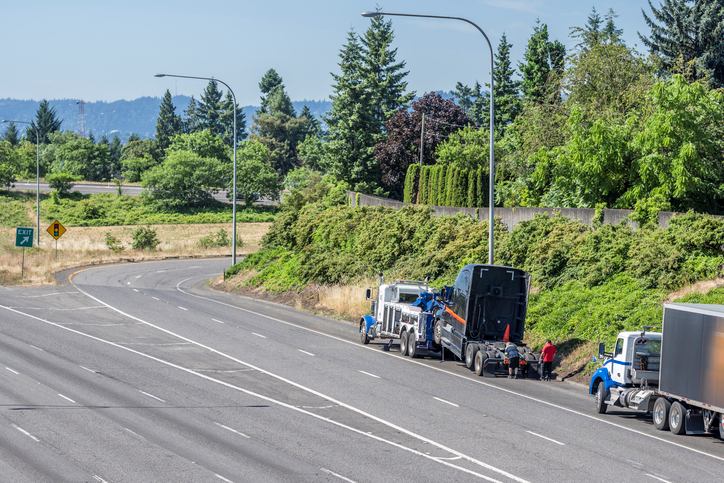
What Constitutes Heavy Duty Truck Towing?
As you’d expect, the vehicle’s weight is a significant factor in determining whether or not it requires a heavy-duty tow truck. Anything over 17,000 pounds requires a heavy-duty tow vehicle, and these tow vehicles are typically rated to tow more than 46,000 or even 48,000 pounds. Some towing vehicles have a Super Heavy-duty rating, and they can tow vehicles over 52,000 pounds. Weight is not the only consideration, however. Sometimes, a towing situation can be challenging, as in the case of a multi-vehicle accident, or vehicles that are stuck in the mud, or down a steep hill. In these cases, there may also be other pieces of heavy duty towing equipment involved, like winches and cranes. Additionally, if a heavy vehicle is carrying something dangerous, like fuel or chemicals, heavy duty trucks and experienced operators will be needed, to ensure safety during the tow.
Essential Heavy Duty Tow Vehicles and Equipment
Heavy duty towing situations involve several different types of equipment.
- The first, and most obvious, is the heavy duty tow truck, also called a heavy duty wrec This type of tow truck can handle heavy vehicles, but there are a few different types of heavy duty wreckers.
- Integrated tow trucks are true workhorses, with extra axles for stability. They also have a boom arm that helps them when recovering large vehicles. Because this arm is built into the truck’s frame, it affords the truck extra strength for difficult jobs.
- Rotator tow trucks are some of the largest tow trucks available. Fitted with a crane-like arm, they can perform crane jobs as well as winching maneuvers. Many operators prefer rotator trucks to using a crane, because these vehicles are better for working in a tight space.
- Flatbed tow trucks are available in sizes that accommodate both smaller and oversized vehicles. With a long, flat platform that can be hydraulically tilted to allow easy loading, these vehicles are good for secure, stable transportation, especially over long distances.
- Boom trucks are designed specifically for lifting. Their hydraulic arm lifts heavy objects and puts them into the correct place, so they’re very useful for situations when a heavy vehicle is in a tricky spot.
- Another important part of a heavy duty towing fleet is the lowboy trailer. Also called a double drop trailer, it has a drop behind the gooseneck and another before the wheels. This allows it to sit very low to the ground, and this makes it easier to transport oversized vehicles without exceeding height restrictions.
- Forklifts and skidsteers handle load transfers and load lifts. These pieces of equipment are often used when cargo needs to be off-loaded from one vehicle and loaded onto another.
When to Use Each Type of Equipment
Of course, each of these types of equipment is suited for particular types of jobs. For instance, an integrated tow truck is a good option for hauling large buses, motorhomes, box trucks, and delivery vehicles. This kind of truck is particularly well-suited to towing large vehicles in urban areas. Flatbed trucks, on the other hand, are good for moving inoperable vehicles without damaging them further, carrying heavy machinery or equipment, and towing vehicles over long distances. If the job requires recovering an overturned semi-truck or tanker, a rotator tow truck is the right vehicle to use. These trucks are also good for lifting construction vehicles from ditches and ravines, and moving large equipment in tight spaces. Boom trucks are the right option when a large vehicle is stuck, whether in mud, snow, water, or a ditch. These trucks are also perfect for lifting heavy objects onto other vehicles, as well as helping with construction site recoveries.
Choosing the Right Heavy Duty Towing Equipment for the Job
Working with an experienced towing company is important, because the team will understand which type of equipment is the best fit for your job. When making this decision, they’ll first consider the weight of the vehicle, and what it is carrying. Then, the severity of the damage must be assessed, along with any challenges presented by the location.
Whether You Need a Heavy Duty Tow Truck or Any Other Kind of Tow, Trust Hawkins Towing
Whenever you need a tow in South Carolina, day or night, Hawkins Towing will be here to help. Our fleet of state of the art towing and wrecker equipment is located in three areas of upstate SC, which means our team can be there to help quickly, no matter where you are or what you’re driving. Our family owned and operated business is fully licensed and insured, and each of our technicians is well trained and experienced in towing services. We know that needing a tow or roadside assistance means you’re in a stressful situation, and we will treat you with respect and courtesy as we work to make everything go as smoothly as possible. Having worked in this area for more than two decades, we’ve earned a reputation for providing reliable service, responding quickly, and being able to handle any situation. Contact us and let us know how we can help.